Voltage
Voltage is expressed in terms of volts (V) which has a relationship of 1 volt is equal to 1 Joule per Coulomb. Voltage is defined as " The work required per unit charge to move charges ". Almost ALL basics circuits contain a voltage source such as the battery, similar to diagram shown below. This picture to help us to understand the idea of how voltage works.
The voltage is like a piston
which pushes the "fluid" through a pipe. This is representing the
voltage pushing current through the circuit.
Current
Current is "The rate of flow of electrons through
a circuit". when you have a battery which is connected to a wire pushing those electric
charges, it creates a current. Current can be thought of as the amount of
charge that passes through a space per unit time (a second usually). Current
is read in the unit of ampere (A). 1 Ampere is equal to 1 Coulomb per second.
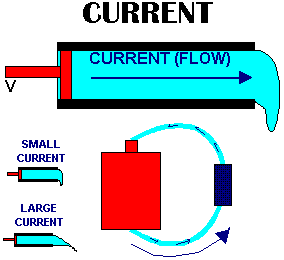
From the picture above, the current
flow moves around the completed loop of the circuit. If the voltage was kept
at a constant ,then the current would be higher with the less amount
of resistance.
Resistance
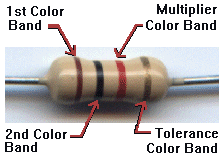
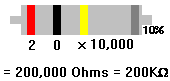
Resistance is " The opposition to the flow of electrons ". FOR EX- The rocks in the river that slow down the movement of the water,and decrease the speed of the flow.
Resistivity is given in Ohms per meter and an example resistivity would be
1.7 x 10^-8 (which is copper, the most commonly used wire material).


0 comments:
Post a Comment