We offer final year projects and In plant Training for EEE, ECE and Instrumentation Students at Hertz (Training Division of VaShIST Tecnologies).
For further details Please contact:
HERTZ (Training Division of VaShIST Tecnologies)
# 42-43, Century Tower,
639, Sathy Road, Near G.P. Signal,
Gandhipuram,
Coimbatore – 641 012.
Phone: 0422 2524204
Mobile: Mr.N.Kumar - 9842224204
Mail : training@vashist.co.in
Motor Basics-I
Motors vs Engines:
• Motors convert electrical
energy to mechanical energy.
•
Engines convert chemical energy to mechanical energy.
Motors:
•
Advantages
1. Low Initial Cost.
2. Simple & Efficient Operation
3. Compact Size – cubic inches/Hp
4. Long Life – 30,000 to 50,000 hours
5. Low Noise
6. No Exhaust Emissions
7. Withstand high temporary overloads
8. Automatic/Remote Start & Control
• Disadvantages
1. Portability
2. Speed Control
3. No Demand Charge
Magnetic Induction:

1. Simple Electromagnet
2. Like Poles Repel
3. Opposite Poles Attract
|
Operating Principle:
Despite it’s relatively old age,
the 8051 is one of the most popular microcontrollers in use today. Many
derivative microcontrollers have since been developed that are based on
compatible with the 8051. A microcontroller
can be defined as computer-on-a-chip
built for dealing with specific tasks or a single task, such as displaying or
receiving information through LEDs or remote controlled devices. The most
commonly used set of microcontrollers belong to 8051 Family.
8051 introduced by Intel in late 1970s. 8051 Microcontrollers are
preferred choice for a most of the community of hobbyists and professionals.
Through 8051,
the world became witness to the most revolutionary set of microcontrollers. Thus,
the ability to program an 8051 is an important skill for anyone who plans to
develop products that will take advantage of microcontrollers.

PIC is a family of modified Harvard
architecture microcontrollers made by Microchip Technology, derived from the
PIC1650 originally developed by General Instrument's Microelectronics Division.
The name PIC initially referred to “Peripheral
Interface Controller”. PICs are popular with both industrial developers
and hobbyists similarly to 8051, due to their low cost, wide availability, more
dependent on user, extensive collection of application notes, availability of free
development tools, and serial programming and also it can be re-programming
with flash memory capability. They are also commonly used in educational
programming as they often come with the easy to use 'pic logicator' software.
A PROGRAMMABLE LOGIC CONTROLLER
(PLC) is an industrial computer control system that continuously
monitors the state of input devices and makes decisions based upon a
custom program, to control the state of devices connected as outputs.
Almost any production line, machine function or process can be automated
using a PLC. The speed and accuracy of the operation can be greatly
enhanced using this type of control system. But the biggest benefit in
using a PLC is the ability to change and replicate the operation or
process while collecting and communicating vital information.
A PLC is an example of a hard real time
system since output results must be produced in response to input
conditions within a limited time, otherwise unintended operation will
result.
A PLC consists of following main parts:
What is a PLC input/output?
|
|
|
|
|
|
Switches and Push buttons
|
|
|
|
|
|
|
|
|
|
|
PLC Operations consist of four steps
1. Input Scan: Scans the state of the Inputs
2. Program Scan: Executes the program logic
3. Output Scan: Energize/DE-energize the outputs
4. Housekeeping
These Sensors can be used to measure the position or change of position of Object. A wide variety of models is available, including Laser Sensors, LED Sensors, Ultrasonic Sensors, Contact Sensors, Eddy Current Sensors, and more.
A wide variety of models is available,
Including optical sensors, Laser Sensors, LED Sensors, Ultrasonic Sensors, Contact Sensors, Eddy Current Sensors and more.
OPTICAL displacement SENSORS
Principle of measurement of the optical displacement sensor
Light from the light source is condensed by the lens and directed onto the object.
Light reflected from the object is condensed onto a one-
dimensional position sensing device (
PSD)
*
by the receiving lens.
If the position of the object
changes,
the image formation positions on the PSD will differ,
and if the balance of the two PSD outputs changes,
the image formation positions on the PSD will differ and the balance of the two PSD outputs changes.
If the two outputs are A and B,
calculate A/
(
A +
B)
and use appropriate values for the span coefficient "
k"
and the offset "
C"
.
The value measured is not the illuminance (
brightness)
,
but the two output displacements A and B,
and thus even if the received light intensity changes because the distance to the object changes,
the result is not affected and linear output proportional to the distance difference and position shift is obtained.
Optical system of the Displacement Sensor
Voltage
Voltage is expressed in terms of volts (V) which has
a relationship of 1 volt is equal to 1 Joule per Coulomb. Voltage is defined as " The work
required per unit charge to move charges ". Almost ALL basics circuits contain a voltage source such
as the battery, similar to diagram shown below. This picture to help us to understand
the idea of how voltage works.
The voltage is like a piston
which pushes the "fluid" through a pipe. This is representing the
voltage pushing current through the circuit.
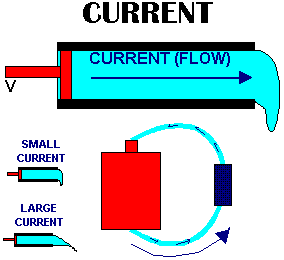
Current
Current is "The rate of flow of electrons through
a circuit". when you have a battery which is connected to a wire pushing those electric
charges, it creates a current. Current can be thought of as the amount of
charge that passes through a space per unit time (a second usually). Current
is read in the unit of ampere (A). 1 Ampere is equal to 1 Coulomb per second.
From the picture above, the current
flow moves around the completed loop of the circuit. If the voltage was kept
at a constant ,then the current would be higher with the less amount
of resistance.
Resistance
Resistance is " The opposition to the flow of electrons ". FOR EX- The rocks in the river that slow down the movement of the water,and decrease the speed of the flow.
Resistivity is given in Ohms per meter and an example resistivity would be
1.7 x 10^-8 (which is copper, the most commonly used wire material).
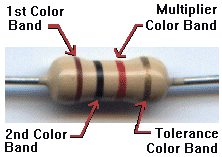
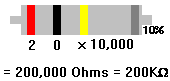
The picture above is of an actual "resistor"
which is a component of a circuit. The bands across a resistor are a color
code scheme to label how much resistance the resistor has.

PLC AND EMBEDDED TRAINING
VASHIST TECHNOLOGIES PLANNED TO START THE TRAINING DIVISION FOR ENTHUSIASTIC AND INTERESTED STUDENTS AND INDUSTRIAL PUPILS.
WE ARE HANDLING INDUSTRIAL PROJECTS AND PRODUCTS ON PLC AND EMBEDDED FOR MORE THAN 10 YEARS.
OUR ENGINEERS HAVE CREDENTIAL TO HANDLE PLC AND EMBEDDED COURSES, WHO HAVE MORE THAN 4 YEARS EXPERIENCE.
COURSES OFFERED:
WE ARE SPECIALIZED IN
ABB
AB
SIEMENS
KEYENCE
BECKHOFF



FOR MORE INFORMATION CONTACT
MOHANA : 9842224201
VISHNU : 9842224206
|
|
|
| A
transformer is a device which is use to convert high alternatic voltage
to a low alternatic voltage and vice versa.
|
WORKING
PRINCIPLE
|
|
|
Transformer
works on the principle of mutual induction of two coils. When current in
the primary coil is changed the flux linked to the secondary coil also changes.
Consequently an EMF is induced in the secondary coil.
|
|
CONSTRUCTION
|
|
| |
A
transformer consists of a rectangular core of soft iron in the form of sheets
insulated from one another. Two separate coils of insulated wires, a primary
coil and a secondary coil are wound on the core. These coils are well insulated
from one another and from the core. The coil on the input side is called
Primary coil and the coil on the output side is called Secondary coil.
|
|
|
WORKING
|
 |
Suppose
an alternatic voltage source Vp is connected to primary coil. Current in
primary will produce magnetic flux which is linked to secondary. When current
in primary changes, flux in secondary also changes which results an EMF
Vs in secondary. According to Faradays law EMF induced in a coil depends
upon the rate of change of magnetic flux in the coil. If resistance of the
coil is small then the induced EMF will be equal to voltage applied. |
We offer final year projects for EEE, ECE and Instrumentation Students at Hertz (Training Division of VaShiSt Tecnologies).
For further details Please contact:
HERTZ (Training Division of VaShiSt Tecnologies)
# 42-43, Century Tower,
639, Sathy Road, Near G.P. Signal,
Gandhipuram,
Coimbatore – 641 012.
Phone: 0422 2524204
Mobile: Mr.Prabhu - 9788890444
Mail : training@vashist.co.in